Ask for a situation, a decision and a change
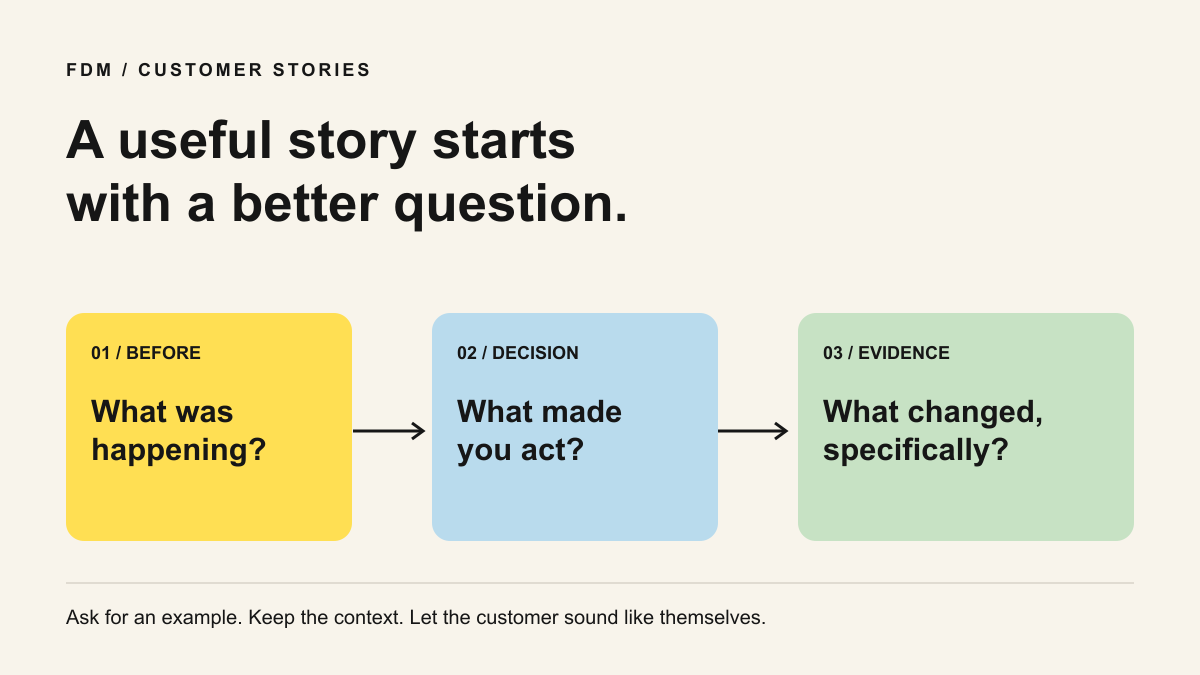
The most useful customer testimonial questions uncover what was happening before, why the customer chose a different approach, what using it was really like and what changed. Ask for a specific example after a broad answer. Do not ask the customer to perform a sales script or agree to a result they cannot substantiate.
Start with the buyer who will watch the film. A finance leader evaluating risk needs a different story from an operator wondering whether a workflow will fit their day. Choose a customer who can speak to that decision from experience. A recognisable logo is helpful, but it cannot replace a relevant story.
Twelve questions to choose from
This is a question bank, not a questionnaire to read without listening. Pick the questions that fit the customer's actual experience. Share the topics beforehand so they can check facts and clear any confidential material. Ask for examples, not rehearsed praise.
- What does your team do, and which part of that work are you responsible for?
- What was happening when you first started looking for a solution?
- Can you describe a recent example of how the old process worked?
- What made that problem important enough to act on?
- What other approaches did you consider, including doing nothing?
- What did you need to see before you felt comfortable choosing?
- What concerned you before getting started?
- What did implementation require from your own team?
- Walk me through one way you use it now.
- What has changed, and what evidence are you comfortable sharing?
- What still needs a person, another tool or a workaround?
- Who would find this useful, and what should they know before starting?
The follow-up matters more than the perfect opening question
If a customer says, 'It saves us time,' ask which task, whose time and how they know. If they cannot give a defensible number, ask them to describe the difference in the workflow. A specific operational change is more useful than an impressive percentage with no clear basis.
Illustrative follow-up: 'You said approvals are easier. Could you describe how an approval travelled through the team before, and how it travels now?' This invites a concrete account without putting a favourable answer in the customer's mouth.
When the answer is vague, use a neutral prompt such as 'What happened next?' or 'Can you give me an example?' Avoid 'So it transformed your business?' That may produce a usable-looking soundbite while weakening the honesty of the interview.
Can you make a strong testimonial without ROI numbers?
Yes. Show a verified change in the way work happens, the reason for choosing the product, or a concern the customer resolved. A buyer may need to know that their team can review work in one place, that a particular integration fits their setup, or that implementation had a manageable sequence. Not every story needs a revenue claim.
If a number is available, record its meaning alongside it: the period, what was measured, who measured it and what else changed. Do not turn an individual's experience into a promise for every customer. If permission to share the figure is uncertain, leave it out until confirmed.
Content Beta and Wyzowl both publish question-led approaches to customer stories. Use those as further reading, not as a reason to force every interview into the same success narrative. The useful missing layer is the evidence behind an answer and the limits the final edit must preserve.
Sources: Content Beta: Video testimonial questionsWyzowl: Testimonial video production and interview approach
Build the edit around one buying question
A practical edit can move from context to friction, then the decision, the experience and the observed change. That is an editorial map, not a mandatory runtime. If the strongest answer needs a qualification, keep it beside the claim rather than cutting it away to make the sentence shorter.
FDM has edited customer testimonial work for SpotDraft. The relevant craft decision is how to retain the customer's manner of speaking while removing repetition. The portfolio shows the work; it does not establish a conversion uplift. Resist making a natural conversation sound like a brand manifesto just because the music and graphics allow it.
Ask for supporting visuals after identifying the story. A permitted product screen, a real workflow or an appropriate workplace shot should explain what the speaker means. Decorative footage of people smiling at laptops is not a substitute for evidence. Never display private customer records to make the edit feel more authentic.
What should be agreed before recording?
Confirm who can approve the use of the person's name, title, company identity and recording, and where the finished film and cutdowns may appear. Agree on the review contact and any claims or information that cannot be shared. Treat this as a permissions checklist, not legal advice or a substitute for your organisation's release process.
For a remote interview, test the microphone, camera framing and recording method before the conversation. Leave a short pause around answers so the edit has clean entry and exit points. Let the person finish a thought before asking for a shorter version. The spontaneous answer may be the one that sounds most credible.
Before delivery, compare the edit with the source interview. Check names, captions, numerical claims and the meaning of any combined sentences. Ask whether a viewer could draw a stronger conclusion than the customer actually expressed. If so, fix the edit rather than hiding the problem in a disclaimer.
Sources and references
- Video testimonial questions · Content Beta · Checked 2026-09-18
- Testimonial video production and interview approach · Wyzowl · Checked 2026-09-18