Buy a defined production service, not a vague number of videos
A podcast-editing retainer should specify the recordings it accepts, the editorial work included, the full-episode deliverables, the short-form outputs, the review process and the monthly capacity. It should also say what happens when a recording is late, unusually difficult or unsuitable for the expected number of clips.
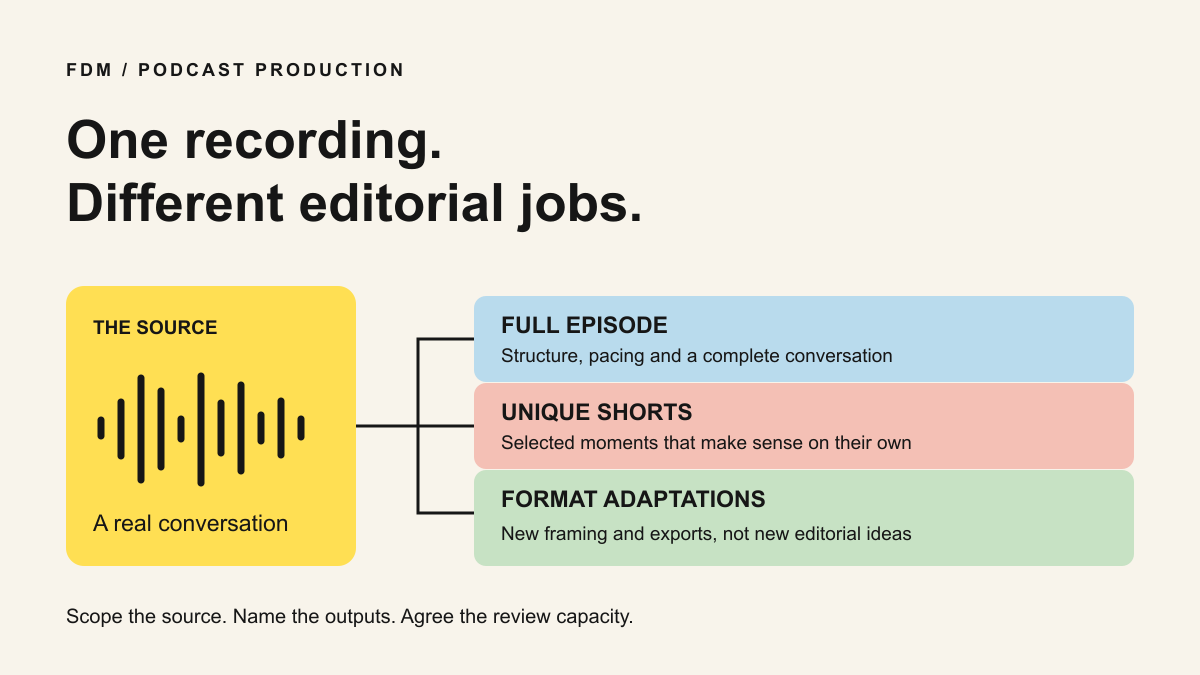
Twenty exports can mean twenty original editorial choices, or five edits delivered in four shapes. Those are not equivalent packages. Ask the supplier to separate unique edits from format adaptations before comparing prices. There is no useful universal price without that scope.
Define the input as carefully as the output
Specify how many recordings arrive each month, their maximum source length, the number of camera angles and audio tracks, and the expected recording quality. A tightly hosted conversation with separate microphones is not the same editing job as several hours of mixed audio with interruptions and missing sections.
Explain whether the editor is expected to remove mistakes, restructure the conversation, check names, add graphics, find supporting material or simply assemble a supplied edit map. If the team must discover the story inside the recording, that is editorial work. It should not disappear inside the phrase 'basic editing'.
Name the transfer deadline and who checks that all files are present. If an episode arrives two days before publication instead of the agreed week, the turnaround agreement needs a defined response. A monthly fee does not create unlimited capacity on any day you choose.
Separate episode editing from clip selection and adaptation
The episode needs its own specification: video master, audio version if required, opening and closing treatment, captions, graphics and any platform-ready extras. Thumbnails, titles, descriptions, chapters and uploading should be explicitly included or excluded. Do not assume 'ready to publish' means the same thing to both teams.
Clips need another specification. Who finds the moments? Who checks that a claim still makes sense outside the interview? Does the clip need a new opening, reframing, captions or graphics? A vertical crop of a finished episode is not automatically a finished short.
Atomik Growth's clipping page describes human review as part of its service, while Increditors discusses clip selection and editing scope. These are useful examples of why the human editorial layer should be made explicit. They are vendor descriptions, not independent evidence that a particular package will deliver your results.
Sources: Atomik Growth: Video clipping servicesIncreditors: Video editing for podcast clips
Worked example: four episodes and twelve clips
Illustrative scope, not an FDM package or quote: four recordings per month, each up to an agreed source length; four edited video episodes; twelve unique short-form edits; one agreed vertical format per short; checked captions; and two consolidated review rounds per deliverable. The actual numbers should follow your recording supply and review capacity.
Now clarify three ambiguities. Are the twelve shorts guaranteed regardless of source quality? Does a second aspect ratio count as another clip? Does a new request to change the editorial angle after approval count as a revision or a new edit? Resolve those questions in writing before the first month.
For example, a single thoughtful answer might support one strong short, not three. Splitting it to meet a quota can strip away the setup and qualification. Agree whether unsuitable source material triggers fewer clips, another recording or a revised content plan. Do not require the editor to manufacture substance.
Check whether your own team can keep up
A retainer can stall because nobody approves the cuts. Map the month from recording to source delivery, first edit, consolidated feedback and publication. Assign one person to resolve conflicting comments. For healthcare and finance, build the relevant subject review into the timetable rather than treating it as an unexpected final step.
Agree how many episodes can be in review simultaneously and how long feedback may remain outstanding. Decide what happens to unused capacity and late source material. These are commercial terms to negotiate, not universal standards. A clear pause or rollover arrangement is more useful than discovering different assumptions after a quiet month.
A paid pilot is often a sensible way to test the relationship before a longer commitment. Use representative footage, not your cleanest recording if most episodes are harder. Review the first draft, the response to feedback and the file handover, not only the final polished minute.
What should you inspect in the pilot?
Listen for awkward cuts, missing context and inconsistent speech levels. Watch the short on a phone at normal speed. Check whether the opening tells a new viewer enough to follow the answer. Verify names, figures and specialist terminology in captions. Confirm that the full episode and the cutdowns do not contradict each other.
FDM's work includes podcast and short-form editing for clients such as PowerUp Money and Kotak Mahindra Bank. Those are relevant examples to inspect for editing treatment, not proof of a universal clip yield or guaranteed reach. Ask any supplier to show work that resembles the recording conditions and audience you actually have.
Keep delivery organised enough for another person to use: episode identifier, version, format, approval status and final destination. Agree on source-file handover, media storage and retention. These details are not glamorous, but they determine whether the retainer leaves you with a usable library.
Measure reliable output and useful audience response
Track whether episodes arrive on time, how much avoidable rework occurs and whether the clips attract the people the show is meant to reach. Views can help describe distribution, but they do not by themselves establish qualified interest or business impact.
If you cannot reliably record or approve work every month, buy by episode until the rhythm stabilises. If the rhythm is already predictable, a retainer can reserve capacity and reduce repeated setup. Choose the arrangement that matches the operation you have, not the content calendar you hope to have someday.
Sources and references
- Video clipping services · Atomik Growth · Checked 2026-09-18
- Video editing for podcast clips · Increditors · Checked 2026-09-18